In software development, testing is fundamental to a product’s success. However, traditional testing—whether manual QA or automated—comes with challenges in terms of cost, accuracy, and scalability. That’s why the use of artificial intelligence in testing processes is rapidly growing, driving effectiveness in software testing.
Today, tools like ChatGPT and Google Gemini—also widely used by developers for code generation—have become popular for automatically creating test cases, optimizing testing scripts, and detecting scenarios that often go unnoticed. When combined with frameworks like Selenium or Playwright, these capabilities allow teams to move from a reactive testing cycle to a proactive, continuous one, integrated directly into CI/CD pipelines.
Challenges of manual testing
Manual testing remains the preferred approach for many development teams. However, it often creates bottlenecks and avoidable delays in product delivery. It also demands sustained human effort and is subject to variability, making it difficult to maintain broad and consistent test coverage.
The main challenges of manual testing include:
- Time-consuming processes, as every scenario must be verified step by step by a tester.
- Variability in results, which depend on each tester’s technical background and level of experience.
- High risk of missing critical errors, since it’s not always possible to test every scenario within deadlines.
In business environments where speed and quality are critical, these limitations can result in costly errors and delays in product launches.
Automatic test case generation with ChatGPT/Gemini
The arrival of AI-powered language models like ChatGPT and Google Gemini is transforming how test cases are designed. These tools can interpret requirements, code snippets, or even technical documentation and automatically generate test scenarios.
For example, with a well-structured prompt, these tools can generate a full list of functional test cases within seconds—dramatically reducing time spent on this task. However, it’s essential that technical staff validate and refine the AI-generated cases, as they can sometimes be incomplete or overly generic.
Example prompts
With ChatGPT or Gemini, you can generate general tests from requirements or create unit tests from code.
For example, with the prompt: “Generate a list of functional test cases for a login system that includes user/password validation, password recovery, and account lockout after 3 failed attempts”; the AI may suggest verifying successful login with valid credentials, validate error message for incorrect user input, confirm account lockout after 3 failed attempts, etc.
Or the prompt: “Analyze the following Java code snippet and suggest unit test cases to ensure correct validation of numeric inputs: [insert function here]”, may cause AI to suggest test cases for valid, null, negative, and out-of-range values.
Which language model to choose?
When comparing the tools, ChatGPT has proven to be more flexible for conversational prompts and practical examples; whereas Gemini is stronger in contextual understanding and structured analysis.
When combined with traditional testing, they provide a powerful synergy—AI acts as a copilot to accelerate test preparation, but never replaces critical QA oversight. These prompts are best seen as a starting point, not a substitute for human review tailored to each project’s architecture.
Automation with Selenium, Playwright, and unit tests
Frameworks like Selenium and Playwright are well-established tools for testing, especially in UI verification.
When paired with AI, their potential expands: AI can generate base scripts simulating user interactions, optimize repetitive steps, or even suggest additional validations. This saves QA teams time in script creation and lets them focus on more complex test cases.
In addition, AI-generated unit tests help ensure each code module is validated from the early stages of the development lifecycle. Together, AI and traditional testing frameworks not only speed up processes but also increase test reliability.
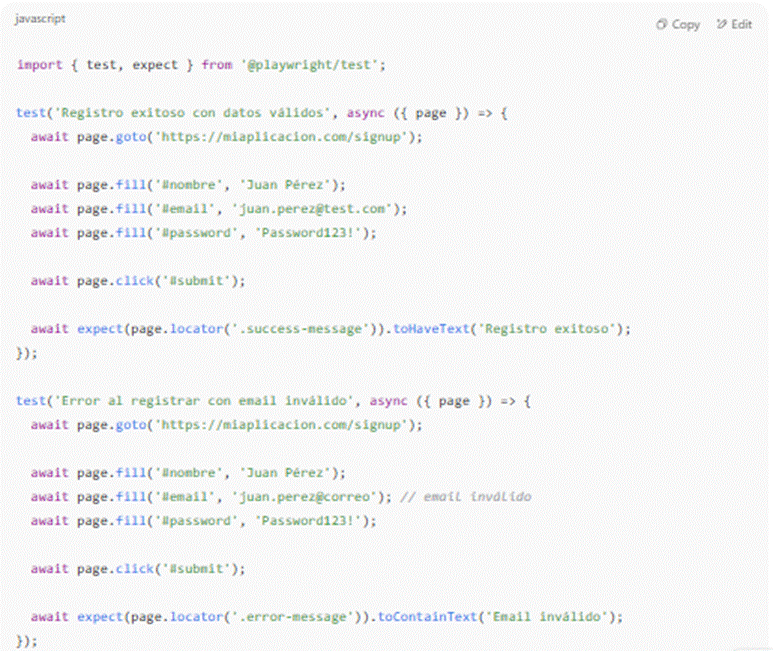
Example with Playwright (JavaScript/TypeScript)
With the prompt: “Generate a Playwright test script to validate that the signup form at https://myapp.com/signup accepts valid data and displays an error message when the email is invalid”, Playwright generates the following code:
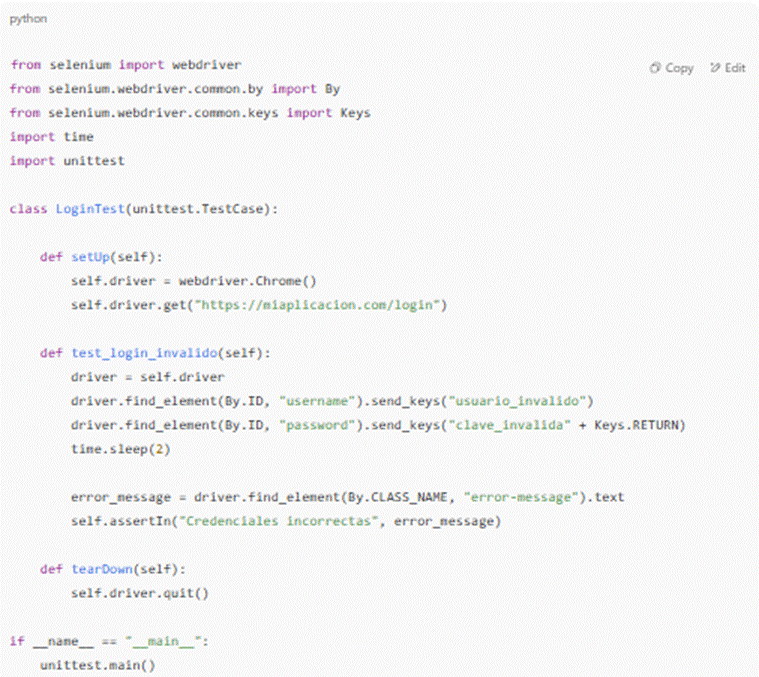
Example with Selenium (Python)
With the prompt: “Write a Selenium test in Python to verify that login fails with incorrect credentials at https://myapp.com/login”, you obtain:
CI/CD pipeline integration
While AI-driven prompts and code generation already enhance QA, the real value emerges when AI testing integrates into continuous integration and delivery (CI/CD) pipelines.
Platforms like GitHub Actions or GitLab CI allow AI-generated tests to run automatically every time new code is introduced, ensuring validations remain up-to-date and aligned with the project’s state.
Automated monitoring and reporting can also be configured, giving developers and QA teams instant feedback. This ensures errors are detected and fixed before reaching production, reducing risks and improving release reliability.
Benefits: efficiency, coverage, reduced human error
AI-powered testing offers organizations—particularly in the B2B space—advantages that extend far beyond reducing manual effort. Key benefits include:
- Time and resource savings: automation drastically reduces time spent on repetitive tasks, freeing QA teams for higher-value work.
- Broader coverage and earlier error detection: AI expands the scope of testing, including edge cases and unusual scenarios often missed in manual testing. Errors are caught earlier, preventing production issues.
- Consistency in software quality: unlike manual testing, which varies by tester, AI-driven automated testing ensures uniformity and repeatability.
Conclusion
Artificial intelligence is reshaping software testing at every level: from automatic test case generation with ChatGPT or Gemini, to execution with frameworks like Selenium and Playwright, and seamless integration into CI/CD pipelines.
For B2B organizations aiming to stay competitive, adopting AI in testing is no longer optional—it’s a strategic necessity. The result: more reliable software, faster development cycles, and more satisfied customers. Turn your QA process into a competitive advantage!