Artificial Intelligence (AI) is no longer a futuristic concept; it is a reality. It is becoming an integral component of business operations. Businesses of all sizes are using AI solutions to drive efficiency and innovation.
A simple example is AI chatbots for customer support, which can handle 80% of customer inquiries and routine tasks. Other than that, you will see AI in action in marketing, sales, HR, reporting, logistics, and almost every business function.
There are endless AI solutions for businesses to embrace today. In fact, it won’t be wrong to claim that business growth and innovation are now linked with how well a company adopts and implements AI across its processes.
In this guide, we will talk about AI solutions for businesses, covering their importance, benefits, real-world applications, and actionable steps to get started with AI in your organization.
What are AI solutions for business?
AI solutions for business refer to tools, systems, and technologies that use artificial intelligence to automate processes, handle repetitive tasks, support smarter decision-making, gather insightful analytics, and more.
The key technologies used in AI automation business solutions include:
- Machine learning: empowers systems to learn from historical data and improve performance over time.
- Natural language processing: allows machines to understand, interpret, and generate human language. Useful for sentiment analysis and virtual assistants.
- Computer vision: enables machines to analyze and interpret visual data from images or videos.
- Robotic Process Automation (RPA): automates repetitive tasks to improve efficiency and productivity, such as data entry, invoice processing, etc.
- Deep learning: uses neural networks to model complex patterns. Useful in speech recognition, fraud detection, etc.
- Generative AI: creates new text, images, codes, or other content for different business operations, such as reporting, marketing campaigns, customer support, etc.
- AI-powered analytics: extracts useful insights from large datasets.
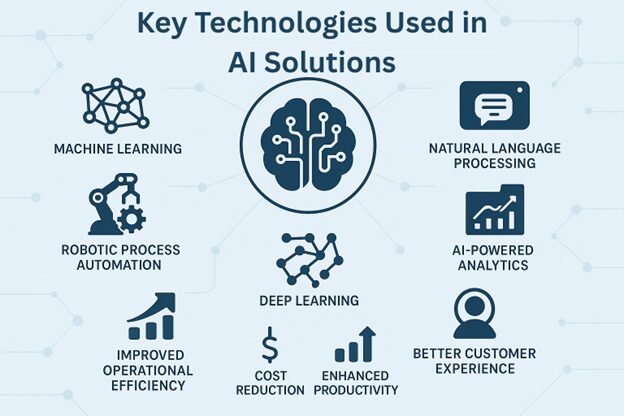
All these AI-backed technologies are meant to improve operational efficiency, reduce costs, enhance productivity, and deliver a better customer experience.
AI vs Traditional Software: Key Differences
Traditional software is a program that follows predefined instructions. It processes input and produces output based on rules and logics without learning and adapting to new situations.
On the other hand, AI software solutions are intelligent tools that learn from data and automate complex tasks through smart decision-making without human involvement.
The key differences between AI vs traditional software solutions include:
- Adaptability: traditional systems remain static, while AI evolves with new data.
- Decision-Making: rules-based software follows fixed logic, while AI makes probabilistic judgments.
- Input Handling: traditional tools require structured data, while AI processes unstructured inputs (text, images, audio).
- Complexity Management: conventional programs handle linear tasks, while AI solves complex problems (sentiment analysis, fraudulent transactions, etc.).
- Self-Optimization: traditional software needs manual updates, while AI autonomously refines its algorithms.
Traditional software has long been used to manage repetitive and predictable tasks, such as payroll processing. However, it’s the AI that brings intelligence and adaptability to these processes.
For example, traditional accounting software simply calculates payroll based on fixed inputs. However, an AI-enhanced system can analyze employee work patterns, predict overtime needs, and even detect potential payroll fraud.
Overall, AI software solutions represent the next generation of traditional ones. They offer companies greater flexibility and intelligence to innovate and stay competitive. Simply put, they turn routine processes into opportunities for optimization and innovation.
Types of business problems AI can solve
AI solutions for business can solve a wide range of problems companies face today. These include:
- Automate repetitive tasks: AI can automate repetitive and manual tasks, such as data entry and scheduling.
- Customer interactions: AI-powered chatbots and virtual assistants can offer 24/7 customer service and fulfill the growing urge for personalized interactions.
- Intelligent decision-making: AI can make smart decisions, such as demand forecasting, fraud detection, and customer segmentation.
- Unstructured data handling: NLP extracts insights from emails, calls, or documents.
- Risk management: AI can suspect and identify security threats and system issues before they occur by recognizing suspicious patterns.
Simply put, AI solutions are ready to handle what businesses consider their most pressing operational challenges and help them evolve in the era of AI dominance.
Key benefits of implementing AI in enterprises
AI adoption in enterprises is steadily increasing. 41.17% of large, 20.97% of medium, and 11.21% of small enterprises have used AI.
The primary drivers for AI implementation include enhanced customer experience and operational efficiency. However, the key benefits enterprises achieve with AI solutions include:
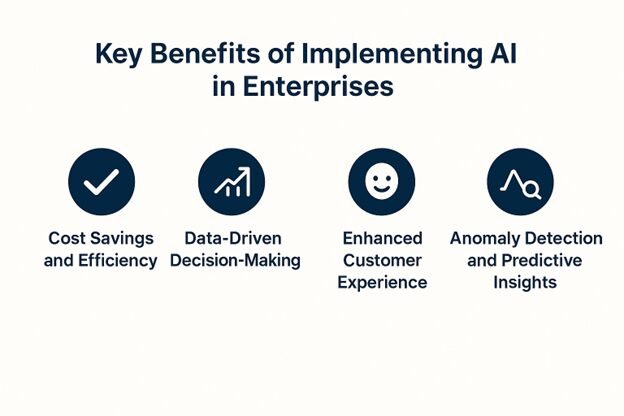
Cost savings and efficiency
AI automates repetitive tasks and improves the efficiency of workflows. This directly reduces operational costs, as lower manpower and resources are required. Recent data indicate that 28% of business leaders are utilizing AI to reduce company costs.
In addition, AI implementation enables the human workforce to work on more strategic tasks, which increases their productivity. For example, the use of generative AI saves employees an average of 1.75 hours per day, which they can utilize in other valuable activities.
Data-driven decision-making
AI enables enterprises to analyze vast amounts of structured and unstructured data and extract actionable insights to make data-driven decisions.
For example, Sprint used AI-powered predictive analytics to identify customers at risk of churn. This resulted in a 10% reduction in churn and a 40% increase in their Net Promoter Score. Similarly, 82% of organizations achieved prominent ROI within two years of using AI analytics.
Enhanced customer experience
Customer expectations and demands from businesses are changing. They want instant and personalized services, which is what AI can offer.
Chatbots, personalized recommendation systems, trigger-based campaigns, and others can improve customer engagement. Sixty-four percent of business owners believe that AI improves customer relations, which leads to higher satisfaction and loyalty.
Anomaly detection and predictive insights
AI benefits are beyond just automation and decision-making. It can identify unusual patterns and predict future trends, which helps businesses manage risks and optimize operations. For example, Danske Bank implemented ML-powered systems and witnessed an increase in fraud detection by 50% and a reduction in false positives by 60%.
5 real-world applications of AI in business
Now that we know the benefits and game-changing role of AI solutions for businesses, let’s take a look at the top five real-world applications of AI:
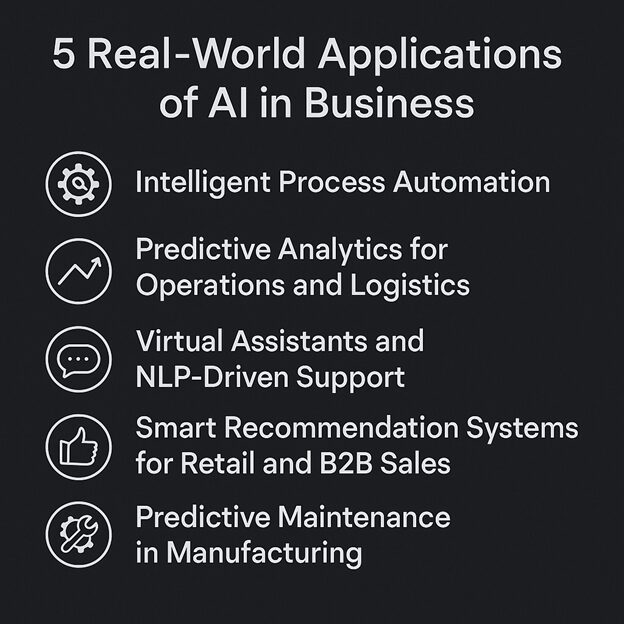
Intelligent process automation (BPM + RPA + AI)
AI automation trends are in full swing, with AI tools automating simple to complex processes with IPA. Intelligent Process Automation (IPA) combines business process management (BPM), robotic process automation (RPA), and artificial intelligence (AI) to optimize end-to-end workflows.
For example, Bancolombia is a leading financial services company in Colombia. It deployed IPA to automate its provisioning and financial processes. This implementation freed up 127,000 hours annually and reduced provisioning costs by $19 million.
Predictive analytics for operations and logistics
AI predictive analytics is a game-changer in operations and logistics. It analyzes historical data and external factors to forecast demand, optimize inventory, etc.
For example, More Retail Ltd. (MRL) is one of India’s top grocery retailers. It partnered with Ganit and used Amazon Forecast to improve demand forecasting accuracy from 24% to 76%. This AI-driven approach reduced fresh produce wastage by up to 30%, increased in-stock rates from 80% to 90%, and boosted gross profit by 25%.
Virtual assistants and NLP-driven support
AI-driven virtual assistants and chatbots use natural language processing (NLP) to provide 24/7 customer support and automate routine interactions.
For example, Vodafone is investing €140 million in AI systems to improve customer service. Its AI chatbot handled 8 million inquiries in Germany, including 65% resolution without human involvement.
Smart recommendation systems for retail and B2B sales
There are now AI recommendation engines that analyze customer behavior and preferences to deliver personalized product suggestions. This approach increases sales and customer loyalty.
For example, Netflix’s recommendation system drives over 80% of the content watched by users. Similarly, Amazon generates 35% of its revenue from the recommendation engine.
Predictive maintenance in manufacturing
AI-driven predictive maintenance monitors equipment health using sensor data to predict failures before they occur. This approach reduces downtime and maintenance costs.
For example, Senseye is Siemens’s predictive maintenance solution. It uses AI predictive analytics, cloud computing, and IoT to monitor the condition of plants and machines using operational and sensor data. It helps clients enhance maintenance efficiency by up to 55% and lower unplanned downtime by up to 50%.
How to get started with AI in your organization
Integrating AI solutions into your organization is not a one-time event but a continuous journey. It requires a clear strategy and phased implementation with iterative improvement.
Below are the three crucial stages for AI integration in your organization:
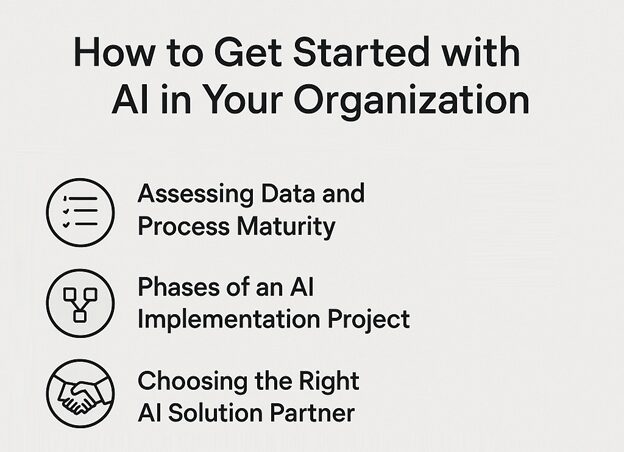
Assessing data and process maturity
First things first, you need to assess your organization’s data, as 85% of AI models/projects fail due to poor data quality. The assessment involves evaluating data availability, quality, and integration capabilities.
Besides that, you also need to evaluate process maturity. It involves assessing the extent to which an organization’s workflows and procedures are structured and optimized to support AI initiatives.
Based on the assessment, you can identify gaps in data infrastructure and pinpoint inefficient processes that are ripe for automation. Moreover, you can prioritize AI use cases that fit with your current business goals.
This foundational stage ensures that AI implementation is built on solid ground rather than guesswork.
Phases of an AI implementation project
The implementation of an AI project involves multiple phases. Let’s look at all the main phases you need to follow:
- Identify and define problem: identify and define business problems that AI will address. Also, set measurable goals and evaluate resource availability.
- Data preparation: collect relevant datasets and clear, label, and split the data for accurate training.
- Model development: build and train AI models using appropriate algorithms, such as NLP transformers for text, CNNs for images, etc. You can also use pretrained models (GPT or BERT).
- Testing and validation: evaluate model performance and refine as needed.
- Deployment: deploy the model into your business processes via cloud APIs, embedded systems, containers, etc.
- Continuous improvement: update models and processes based on feedback and new data.
To understand how to implement AI in your organization, let’s take an example of a telecom company that reduced call volume by 35% with an AI chatbot for billing inquiries. The phase-by-phase implementation was as follows:
- Defined the goal to automate repetitive billing questions.
- It was trained with 50,000 previous tickets to recognize requests for ‘payment extension’ vs. ‘disputes’.
- Launched in 3 months on the company’s website and mobile app and achieved an 88% resolution rate.
This way, you can follow the above phase-by-phase approach to implement AI solutions into different business operations.
Choosing the right AI solution partner
The above phases of implementing AI solutions for businesses look straightforward and well-organized, but they need a skilled workforce and in-house resources. Therefore, it is recommended to partner with the right AI solution partner that can facilitate the entire AI integration journey.
You need to select a partner that has expertise in your industry and a well-reputed name in the market. When looking for a partner, some of the key factors to consider include:
- Technical capabilities
- Industry experience
- Review completed projects
- Upskilling programs
- Post-launch support
- Regulatory compliance
- Cost transparency
With the right AI solution partner by your side, you will be in a better position to integrate AI into your business operations at a faster and more impactful pace.
Conclusion
According to a survey by McKinsey & Company, 78% of respondents stated that their organizations already use AI in at least one business operation.
It’s now or never for companies to embrace AI adoption. Those who will integrate AI solutions into their business strategies are on track to innovate and gain a competitive advantage. In fact, 85% of C-suite executives consider AI the key driver of their growth strategies.
Therefore, we will wrap up by recommending that businesses like yours prioritize AI adoption and partner with an experienced vendor for impactful integration.