Artificial intelligence is transforming recruitment processes, enabling Human Resources teams to analyze large volumes of resumes with greater accuracy, consistency, and speed.
Based on job requirements—such as skills, experience, or technologies—AI can automatically evaluate incoming resumes, assess how well each candidate matches the role, and generate a ranking of the most relevant profiles.
The result is more agile and strategic hiring processes, allowing companies to fill positions on time and maintain their pace of operations without sacrificing efficiency.
The challenge of filtering hundreds of resumes in recruitment processes
In many recruitment processes—especially in medium and large companies, and when hiring for popular roles—it is common to receive between 100 and 500 applications for a single position. This creates several challenges for recruitment teams, whose goal is to identify the ideal candidate among hundreds of profiles. Along the way, they must deal with:
- A slow and demanding manual review process
- The risk of overlooking strong candidates in the volume of resumes
- Difficulty evaluating candidates objectively without clear comparison criteria
- A lack of consistent selection standards
In many cases, these challenges lead HR teams to over-focus on operational tasks, leaving aside qualitative analysis, in-depth interviews, and candidate experience.
This is where artificial intelligence applied to recruitment can transform the process.
How AI works for resume screening
Implementing AI in HR begins with clearly defining the job opening. From there, the system can automate a large part of the analysis process.
Defining the job opening
The first step in applying AI in HR is to properly structure the job opening. This means translating the role’s requirements into clear, measurable criteria that the platform can interpret.
Based on this definition, the system understands what type of profile to look for and how to evaluate each application. The more precise the requirements, the more relevant the analysis and ranking will be. Examples include:
- Education
- Years of experience
- Specific skills
Resume upload
Once the job opening is defined, the next step is to input Once the job opening is defined, the next step is to input resumes into the system for analysis. This process can adapt to each HR team’s workflow:
- Connecting AI to an email inbox (to automatically analyze incoming resumes)
- Uploading documents manually
- Integrating with the organization’s website form
- And more! Since the process is fully customizable, it can be tailored to each company’s reality.
This flexibility allows the solution to integrate with existing recruitment channels without requiring changes to current workflows.
Automated resume analysis with AI
Once uploaded, the platform processes all resumes automatically:
- Analyzes all received resumes
- Identifies skills, experience, and education
- Interprets information even across different formats
- Compares each profile against the defined job requirements
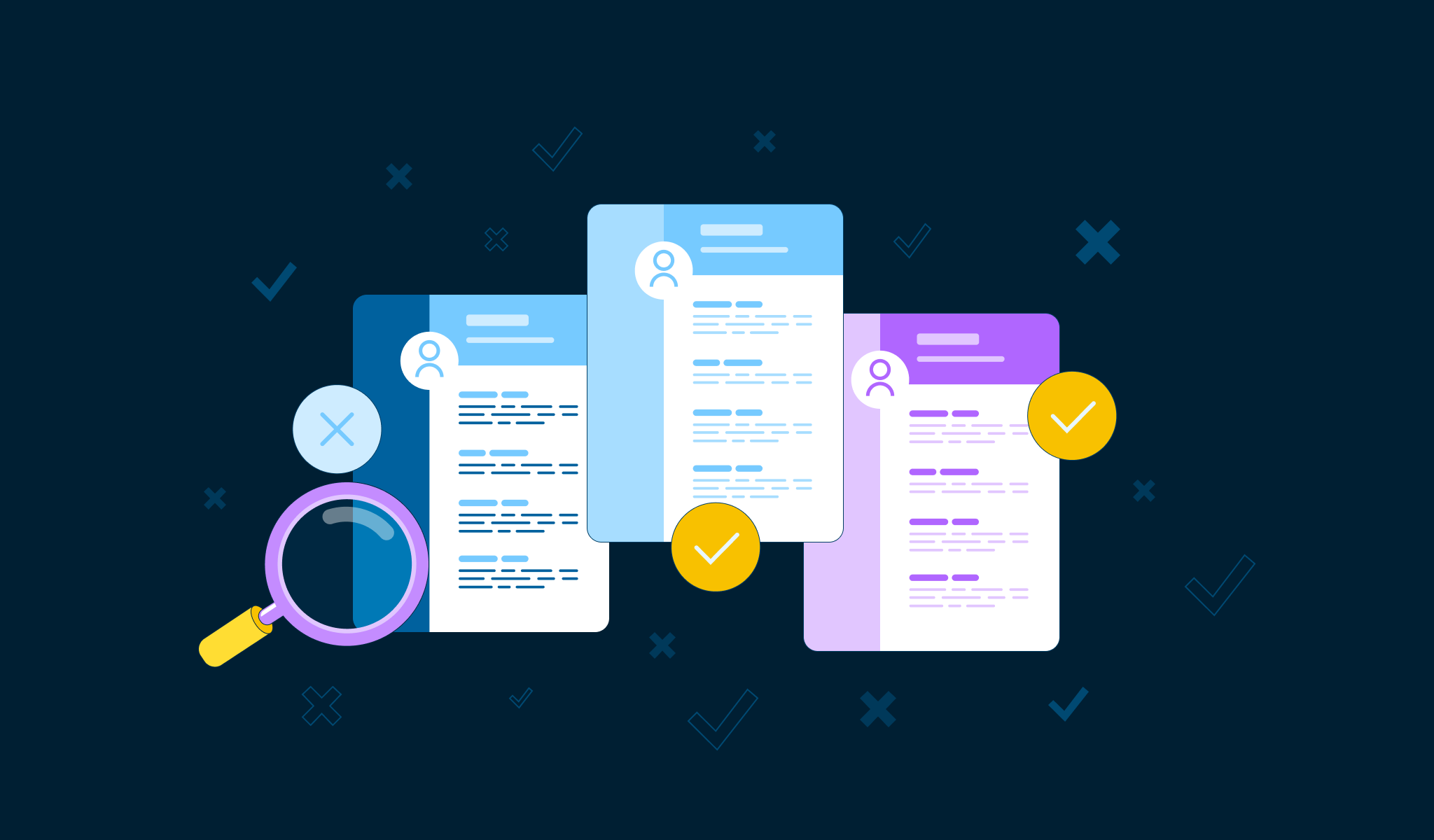
After the analysis, the tool generates an automatic ranking of the most relevant candidates, ordering all resumes from the best match to the least suitable. It also provides a compatibility score for each candidate.
Exclusion filters to improve process quality
Before analysis, exclusion criteria can also be defined, such as a minimum number of years of experience. If a candidate does not meet these requirements, they are automatically discarded—even if they score well in other areas. This helps prioritize interviews and significantly speeds up the selection process.
Benefits of artificial intelligence in Human Resources
Implementing AI in recruitment processes not only saves time but also improves decision quality.
By automating repetitive tasks and relying on structured data, HR teams can work more strategically, focusing on what truly adds value: human judgment and team building.
Reduced hiring time
The most immediate impact is speed. AI can analyze hundreds (or even thousands) of resumes in minutes—something that could take days or weeks manually.
This drastically reduces pre-screening time and allows teams to move faster to interview stages, avoiding the loss of strong candidates due to delayed responses.
More objective selection processes
AI evaluates candidates based on predefined criteria, bringing greater consistency to the process. By removing much of the initial subjectivity, it reduces unconscious bias and ensures that all profiles are assessed using the same standards.
This not only improves selection quality but also strengthens process transparency.
Better talent identification
Thanks to its analytical capabilities, AI can detect meaningful matches between candidate profiles and job requirements—even when they are not immediately obvious.
For example, it can identify connections between:
- Experience
- Skills
- Job requirements
This enables the discovery of talent that might be overlooked in manual reviews, especially in high-volume recruitment processes.
Greater efficiency for HR teams
By delegating initial screening to AI, HR teams can focus on higher-value tasks. This improves both productivity and decision quality, as recruiters have more time to deeply evaluate top-ranked candidates and focus on the next stages: interviews, technical assessments, and final decisions.
Scalability in recruitment processes
AI enables companies to scale recruitment processes without proportionally increasing team resources. It is especially useful for organizations managing multiple openings simultaneously or receiving large volumes of resumes on an ongoing basis.
This ensures consistent process quality, even during periods of growth or high demand.
It is ideal for companies that:
- Receive large volumes of resumes
- Manage multiple job openings simultaneously
Conclusion
Automating resume screening and evaluation with artificial intelligence not only improves efficiency but also enables more informed and strategic decision-making.
At Urudata Software, we develop automation and artificial intelligence solutions tailored to each company, including tools to optimize recruitment processes and resume analysis. If your organization is looking to streamline hiring and find better talent in less time, AI can be the starting point.