Every week, new artificial intelligence models are released. Some promise stronger reasoning capabilities, others deliver better performance in coding or conversations, and many compete to be “the most powerful.”
However, when developing AI solutions for businesses, the release date is not the most important factor. For Urudata Software’s R&D team, choosing the right model for each project is about finding the optimal balance between quality, speed, and cost.
There is no single perfect model for every solution
Each artificial intelligence project presents different challenges. Some require understanding complex documents, while others focus on classifying information, extracting data, maintaining conversations, or automating specific tasks. That’s why there is no single model capable of delivering the best results across every scenario.
At Urudata Software, our R&D team begins each project by analyzing the solution’s requirements and conducting comparative tests with different models before defining the most suitable technological architecture. Model selection is an integral part of this research process and is always driven by the specific needs of each use case.
The best cost-performance ratio for every feature
A common misconception is that the newest model is always the best one. In practice, that is not necessarily true. A common misconception is that the newest model is always the best one. In practice, that is not necessarily true. Many business tasks simply do not require the advanced reasoning capabilities of the latest generation of models. If the goal is to summarize documents, classify information, or extract structured data, there are significantly more cost-effective models that deliver virtually the same results.
For that reason, our team follows a straightforward strategy:
- Start with the most efficient models.
- Evaluate their performance on the real-world use case.
- Scale up only when the complexity of the problem requires it.
This approach enables us to build high- performing solutions without introducing unnecessary costs for our clients.
Different features can use different models
A single solution can combine multiple AI models, each specialized for a different task. Rather than selecting one model for the entire project, we can optimize model selection at the feature level.
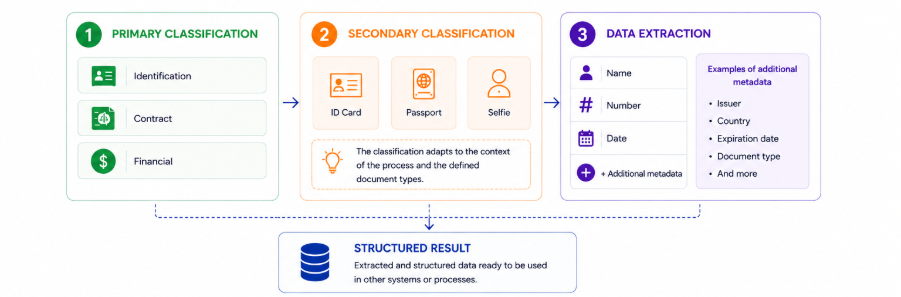
One example is our intelligent document classification solution.
When a user uploads a batch of scanned documents, the process is divided into multiple stages.
- First, one agent identifies the general document type.
- Next, a second agent performs a more detailed classification.
- Finally, another agent extracts only the relevant data for that specific document type.
Each stage can be configured with a different model, depending on the level of complexity involved.
As a result, simpler tasks run on faster, more cost-efficient models, while only the stages that truly require greater reasoning capabilities use more advanced models.
Research as an integral part of development
At Urudata Software, the name of our R&D team is no coincidence. In artificial intelligence, research and development are inseparable.
This requires staying constantly up to date. The AI ecosystem evolves week by week: new models emerge, existing models improve their capabilities, and pricing changes continuously. A key part of our R&D work is evaluating these developments and determining in which scenarios they provide a genuine advantage.
Every technical decision is backed by evidence gathered through our testing process. Rather than selecting a model because it is the newest, the most popular, or the most highly reviewed, we adopt it only after it proves to be the best option for the feature we are building.
Every new capability begins with a simple question: Which model solves this problem most efficiently for the client? Only after that research phase do we define the final solution architecture and integrate the selected models.
Conclusion
Artificial intelligence is evolving at an unprecedented pace, and so are the opportunities it creates for organizations. In this landscape, the real competitive advantage is not simply having access to the latest models, but knowing how to evaluate, combine, and apply them strategically according to the needs of each solution.
At Urudata Software, we believe that developing AI-powered solutions requires an ongoing commitment to research. That is why our R&D team continuously analyzes, tests, and validates every alternative before incorporating it into a product, ensuring that every technological decision is based on objective criteria for performance, cost, and customer value.
Ready to accelerate your business with innovative AI solutions? Contact us